
The "Care Tag" Activity: A Simple Way for Your Whole Family to Talk About Big Feelings
August is transition season. Summer's ending, school's starting, and with it comes a wave of big feelings for kids (and adults!). I've found that during times like this, the most helpful thing isn't reassurance, it's understanding: knowing what each person actually needs when they're overwhelmed. That's where one of my favorite family art therapy activities comes in: the Care Tag Project.
Think about the last time you looked at the tag inside your favorite sweater. Machine wash cold. Lay flat to dry. Do not bleach. These instructions are meant to be straight-forward and easy to understand so whoever's washing it knows exactly how to take care of it without ruining it.
Now, think about how you would take care of yourself in moments when you feel overwhelmed, sad, angry, anxious or otherwise just not ok. Invite the family to sit down together and have each member create a care tag for themselves. It can be playful, more visual than verbal, and it can open up conversations that can be surprisingly hard to have with words alone.
Why art instead of just talking about it?
As an art therapist, I lean on expressive arts because the act of creating does something a conversation can't. When you're asked to draw or design rather than explain, you access feelings before you've fully found the words for them. This can be incredibly helpful for kids who may have trouble putting some of these things into words. And, let’s face it, even as adults it can be hard to verbally express things sometimes, too. Art therapy has been shown to be an effective way to understand family dynamics and strengthen family communication, and its benefits show up across every age group, which is part of why this activity works whether you have a six-year-old, a sixteen-year-old (although you might get some eye-rolls), or a partner at the table.
Art therapy helps people process feelings they may not otherwise have language for, building self-awareness and the ability to work through problems in different ways. A 2020 study specifically found that expressive arts therapy improved emotion regulation in elementary school-aged children, and similar effects have shown up with teenagers. A study on adolescents found a meaningful link between self-compassion and emotion regulation after expressive arts work. In other words: making something with your hands about a hard feeling can help you manage that feeling better, not just express it.
How to do the activity:
What you'll need: paper (an index card works!), markers, crayons, or colored pencils (optional: a hole punch with string or ribbon if you want to make them hangable)
The prompt: Ask each family member to design a tag for themselves, just like a clothing label. It should include:
A symbol or icon representing the feeling and/or the instruction (see examples)
"Care instructions": This can be done in the “clothing-label style”: Do not raise voice. Handle gently. Needs space, not solutions. Give me quiet time before we talk. Or whatever feels most natural. If someone wants to only use symbols, that works, too. Encourage them to explain the symbols at the end.
Some tags even include a "warning label" expressing what not to do like: Do not hug. Avoid loud noises.
I encourage the use of humor here, too (“do not iron when emotional” or “screen-time to remove stains”): it gives distance from the feeling while still addressing it.
Here are some examples I have recreated from the past:
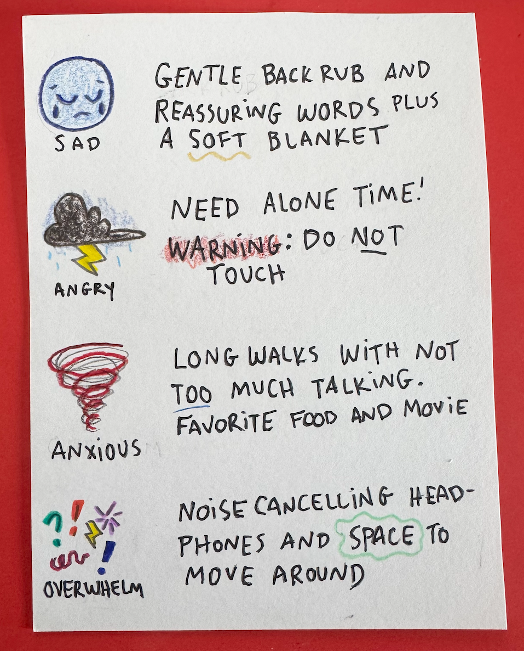
Example 1: This tag leads with the feelings and each gets different instructions.
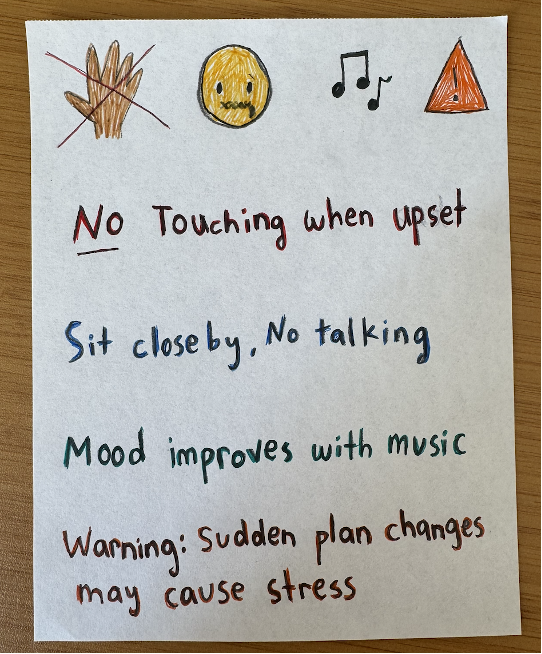
Example 2: This tag leans into the symbolic.
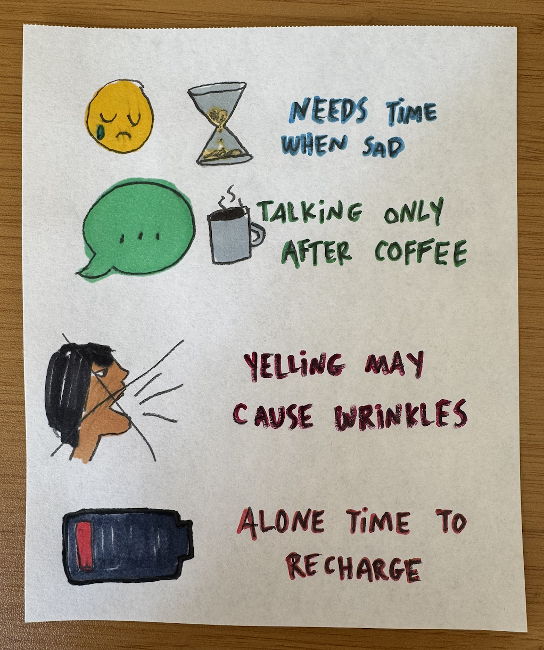
Example 3: This tag incorporates more humor while still reflecting specific needs.
Once everyone's tag is done, go around and share them out loud. Don’t skip this part; some kids might just use symbols and it helps to have them explain their meaning. I recommend keeping the tags somewhere visible like taped to bedroom doors, stuck on the fridge, or hole-punched and hung together on a ring in the kitchen. That way they can become a shared reference point, a family "manual" for how to care for each other during hard moments.
References
Nazeri, A., et al. (2020). The Effect of Expressive Arts Therapy on Emotion Regulation of Primary School Students. Quarterly Journal of Child Mental Health.
Rama Vijay Sane, Mrunmayee Kulkarni, (2024), "The Impact of Expressive Arts Therapy on Emotional Regulation and Self Compassion among Adolescents", International Journal of Science and Research (IJSR), 13(10), 1739-1744.