
The Gift of Being Bad at Something
By: Julia Heffernan, LCAT, ATR-BC
I recently joined a pottery studio. It’s a fairly new art form for me, and to be honest… I’m not very good at it. But what surprised me most is how much I’ve actually been enjoying it! As someone for whom creativity has always felt familiar, being “bad” at a creative practice was unexpectedly vulnerable. Many of us, especially those who identify as capable or high-achieving, carry an unspoken pressure to be competent. We often expect ourselves to succeed quickly, even at something new. When that doesn’t happen, our inner critics can get very loud.
Something shifted when I gave myself permission to simply be bad at pottery. Once I let go of needing to do it “right,” the pressure eased. Curiosity replaced performance. Exploration replaced self-judgment. I began to enjoy the process for what it was: messy, unpredictable, and imperfect. Many of us were taught, directly or indirectly, that there are right and wrong ways to do things. Over time, mistakes stop feeling like information and start feeling like failure. From a neuroscience perspective, this makes sense. Our brains prefer the familiar and the comfortable. Learning something new requires effort, and effort can register in the nervous system as discomfort or even danger.
Perfectionism often appears here, not as a drive to do better, but as a way to protect ourselves from vulnerability. At its core, perfectionism reflects a lack of trust in our ability to recover from getting things wrong. Research on motivation and the brain supports this. Dopamine (that famous neurotransmitter associated with pleasure and reward) is not primarily released when we achieve a goal. Rather, it is released during the pursuit of something we care about. Curiosity, effort, and engagement activate the brain’s reward system more reliably than the outcome itself.
This matters deeply for children.
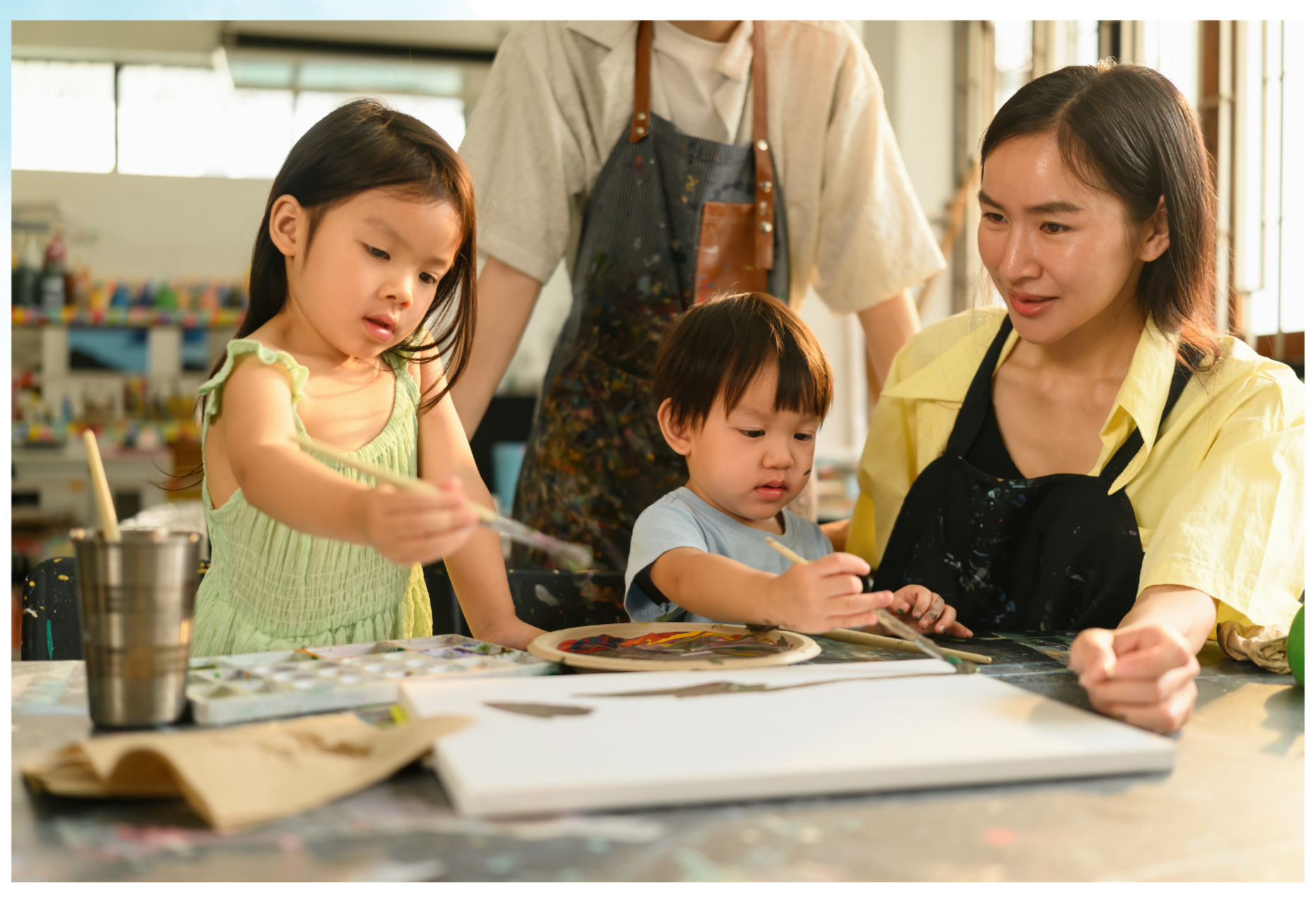
Kids are constantly watching how adults handle frustration, uncertainty, and mistakes. When they see adults avoid new challenges or become self-critical, they learn that struggle is unsafe. When they see adults try, fail, adjust, and try again, they learn something far more powerful: struggle is survivable, and learning is possible. This lines up with what we know about neuroplasticity and the brain’s lifelong capacity to change. Every imperfect attempt strengthens adaptability and resilience.
Perhaps the gift, then, is allowing ourselves to be beginners, to try new things without tying our worth to the result. In my pottery practice, pieces collapse. Clay cracks. Glazes surprise. Instead of focusing on the results, I focus on the experience. When we do that, we not only support our own growth, we model for our children a kinder, more sustainable way to learn and be.
So, the next time you’re drawing with your child, laugh together about how hard it is to tell what the picture is supposed to be. When you’re playing a game with your little ones, take the focus off of winning or losing and name how much fun you had, even if you weren’t very good at it. Try something unfamiliar and narrate the experience aloud. Name how awkward, challenging, or hard it feels. These small moments quietly teach that learning doesn’t require perfection and can invite us, too, to be more willing to try new things.
References:
Margulieux, L., Prather, J. & Rahimi, M. The Biological Benefits of Failure on Learning and Tools to Manage the Fallout. Educ Psychol Rev 37, 33 (2025). doi.org/10.1007/s10648-025-10013-7
Schroder HS, Fisher ME, Lin Y, Lo SL, Danovitch JH, Moser JS. Neural evidence for enhanced attention to mistakes among school-aged children with a growth mindset. Dev Cogn Neurosci. 2017 Apr;24:42-50. doi: 10.1016/j.dcn.2017.01.004.
Schultz, W. Dopamine reward prediction-error signalling: a two-component response. Nat Rev Neurosci 17, 183–195 (2016). https://doi.org/10.1038/nrn.2015.26